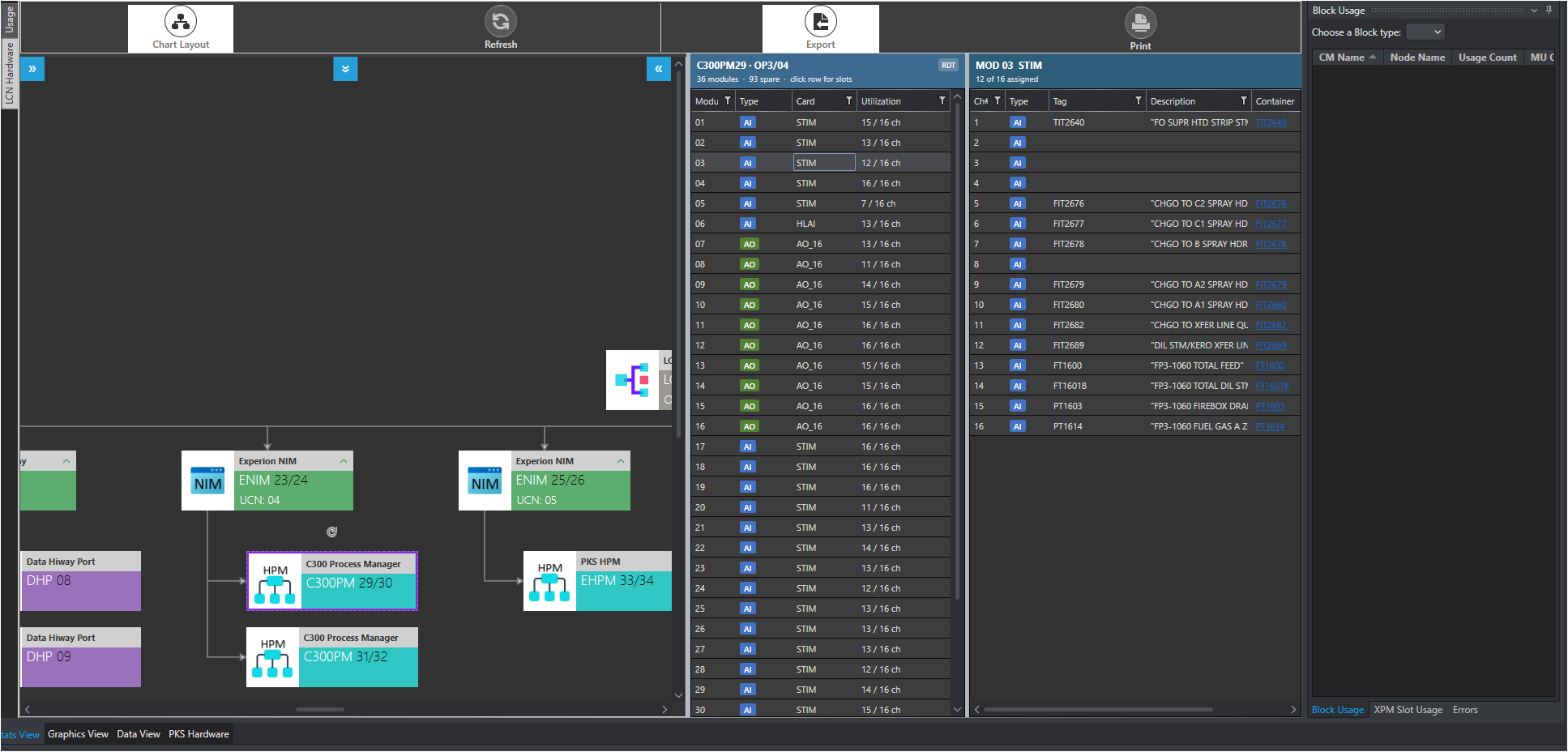
The LCN I/O Spares Management module tracks the reservation status of every spare I/O slot on the Honeywell TPS/LCN xPM controllers (PM, APM, and HPM) in a configuration asset collection. It provides the same structured, auditable workflow as the PKS Hardware View, so project engineers can claim spare slots for upcoming work, field technicians can confirm allocations, and plant management can see at a glance what is available, what is committed, and what has gone stale.
Why It Exists
In a large TPS/LCN installation, spare xPM I/O slots are a limited and shared resource. Without a central record, two engineers may independently promise the same spare slot to different projects, or a slot may sit reserved long after the project it was earmarked for has been canceled or completed. LCN I/O Spares Management replaces spreadsheets and email chains with a live database record that is visible to every authorized user the moment it is saved.
LCN Hardware Hierarchy
The LCN Hardware View organizes xPM I/O in the following hierarchy:
LCN - the Local Control Network, containing one or more UCNs.
UCN - a Universal Control Network, containing one or more xPM controllers.
xPM Controller (PM / APM / HPM) - the equivalent of a PKS C300 controller.
I/O Module (IOP card) - a single I/O type (AI, AO, DI, or DO) hosting 8 to 32 slots.
Slot - an individual I/O channel on the module that can be assigned, spare, or reserved.
Key Capabilities
Capability
Summary
Slot Reservation
Reserve any spare xPM I/O slot for a named project, with an optional undo date and free-text note. See Slot Reservation.
Reservation Statuses
Every slot carries one of six statuses - None, Available, Reserved, Assigned, Released, or Stale - that reflect its full life-cycle. See Reservation Statuses.
Rescan xPM I/O Assignments
Rebuilds the index of which xPM slots are assigned to points, from the stored configuration assets. See LCN Hardware View.
Reconcile
Compares all IOSparesDb reservation records against the current xPM hardware topology and flags discrepancies. See Reconcile I/O Reservations.
Stale Reservation Report
Lists all reservations whose undo date has elapsed without being manually cleared. See Stale Reservation Report.
Four roles (Viewer, Engineer, Technician, SuperAdmin) govern who can reserve, release, override, and administer user accounts. See Roles and Access Control.
User Administration
A SuperAdmin can register new Windows accounts, change roles, and activate or deactivate accounts without leaving the application. See User Administration.
Where the Data Lives
All reservation records are stored in the IOSparesDb MongoDB database in the ModuleIO collection - the same collection used by the PKS Hardware View. User account records are stored in the _pks_io_users collection in the same database, so a user's role applies to both the PKS and LCN Hardware Views.
xPM records are distinguished from PKS records by their key values:
Field
xPM value
Example
Controller
Node type and node number
HPM13
IO Link
LCN / UCN network path of the controller
LCN01/UCN10
Module #
I/O Module number (MODNUM)
5
Channel #
1-based slot number (SLOTNUM)
12
Hardware Template
XPM_IO: followed by the IOP card type
XPM_IO:HLAI
Note IOSparesDb is independent of the main Control Architect asset database. Reservation records persist across configuration snapshot imports and remain valid when LCN data is re-imported or the collection is reloaded.
Getting Started
1. Open a configuration asset collection containing imported LCN data and select the LCN Hardware tab.
2. Your Windows account is automatically registered as Viewer on first launch, or as SuperAdmin if you are the very first user.
3. If you need a higher access level, ask your site SuperAdmin to promote your account via User Administration.
4. Click an xPM controller node, select an I/O Module, then click a spare slot to open the Slot Reservation dialog.